Last updated October 31, 2026
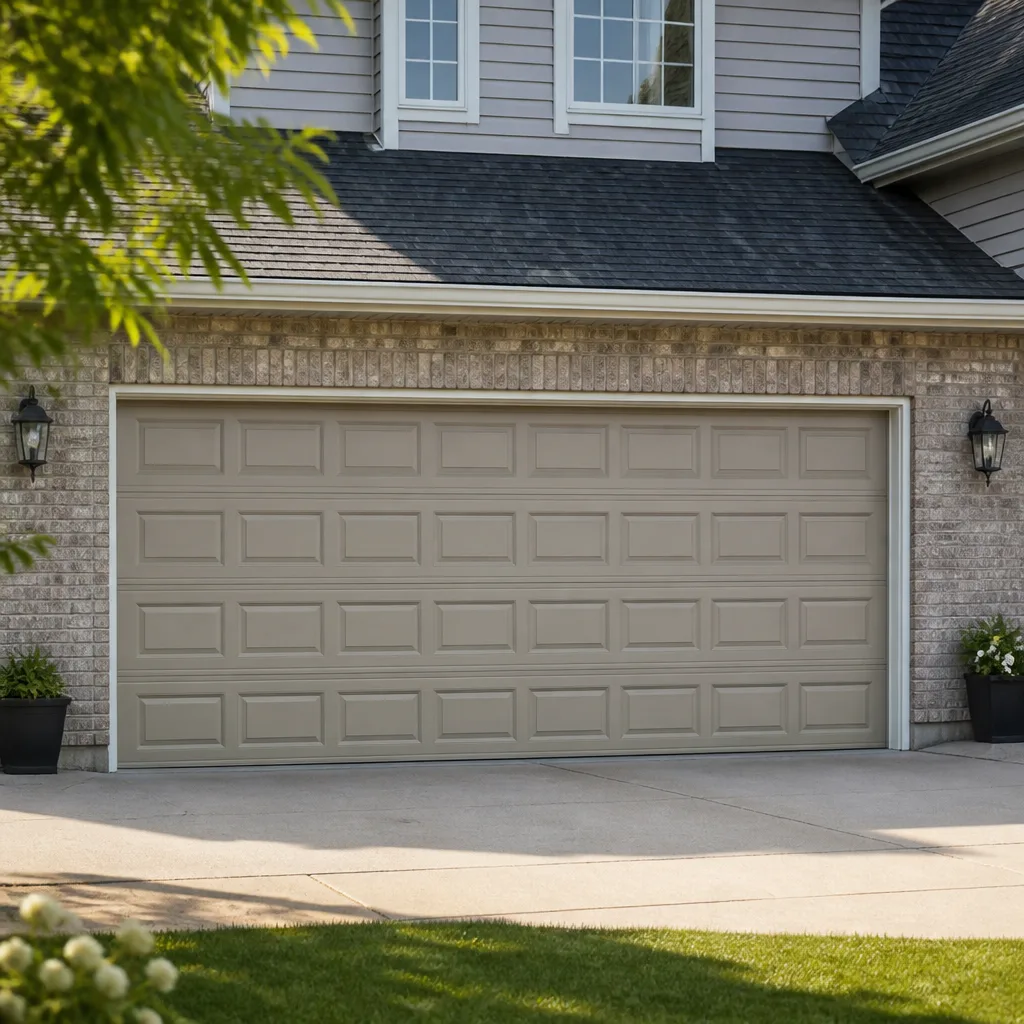 Raised-panel steel
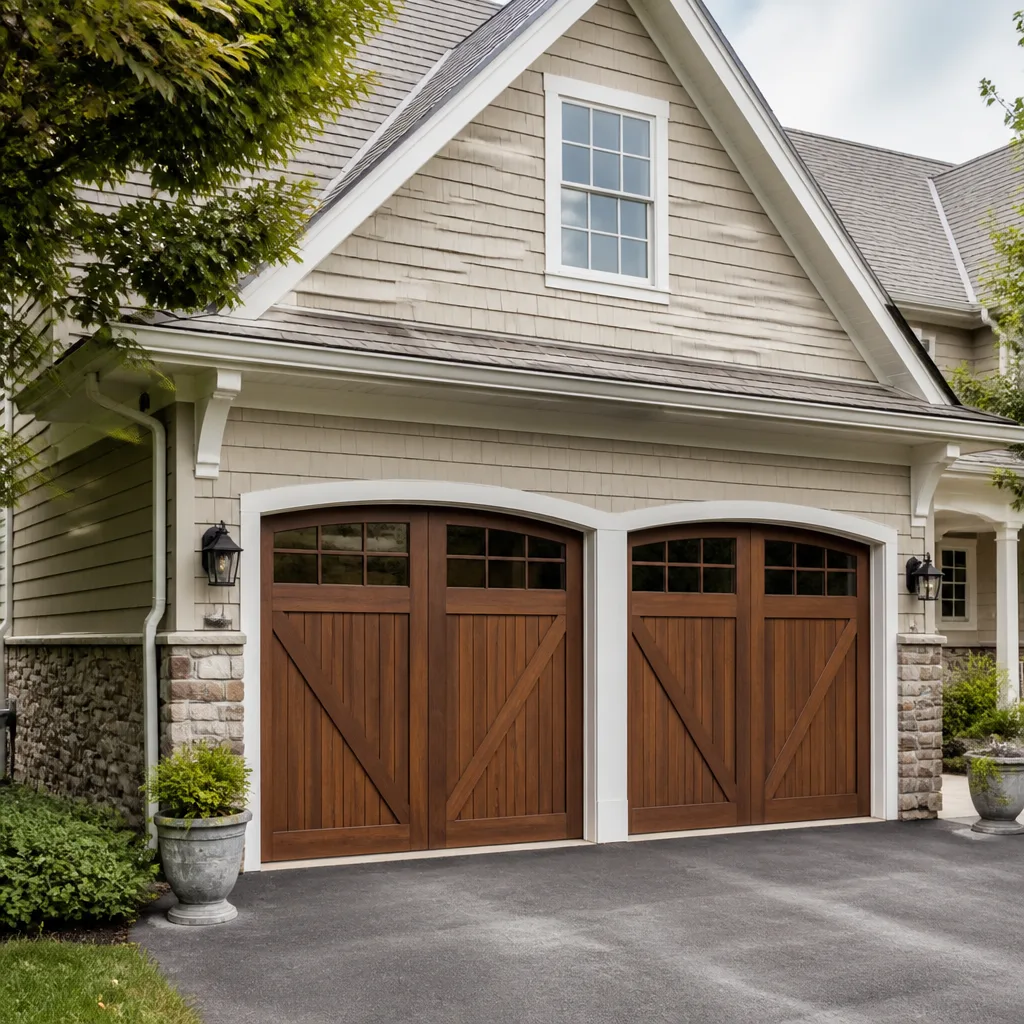 Carriage house
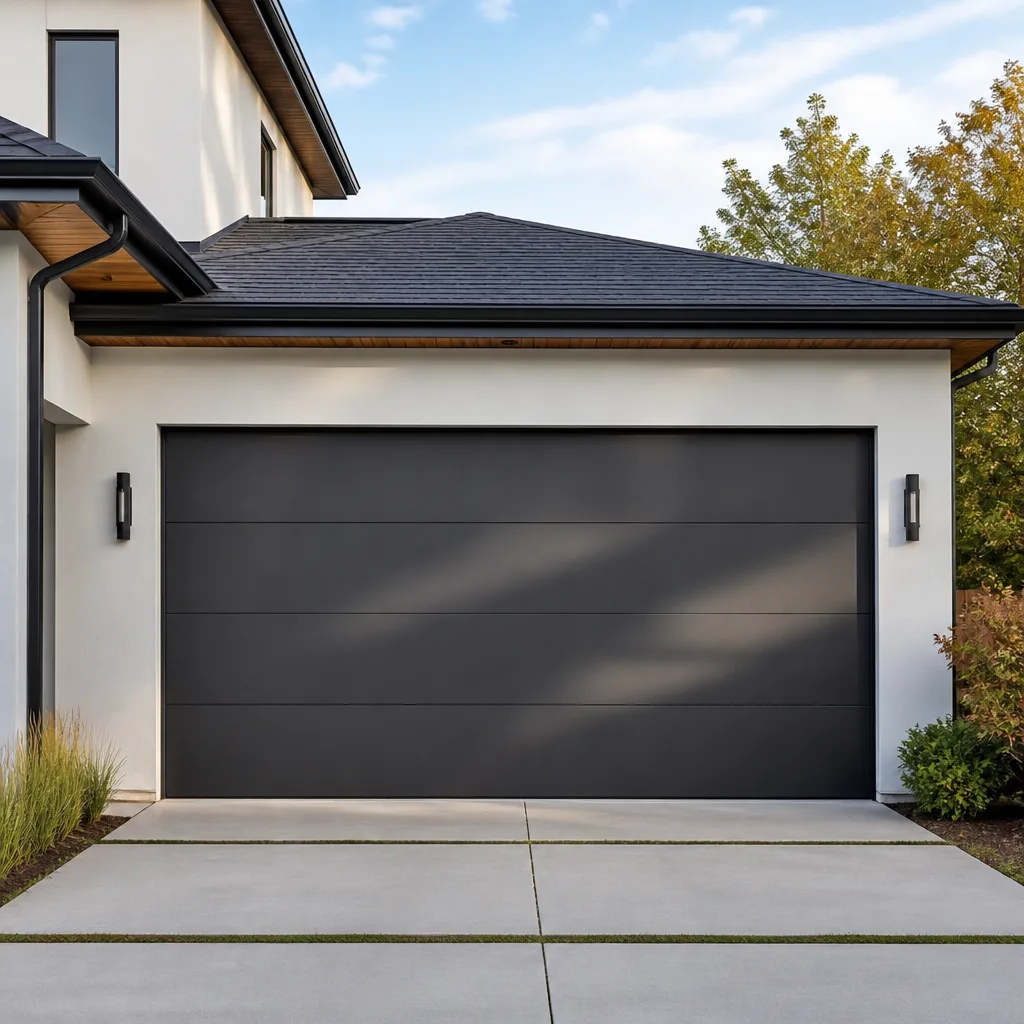 Modern flush
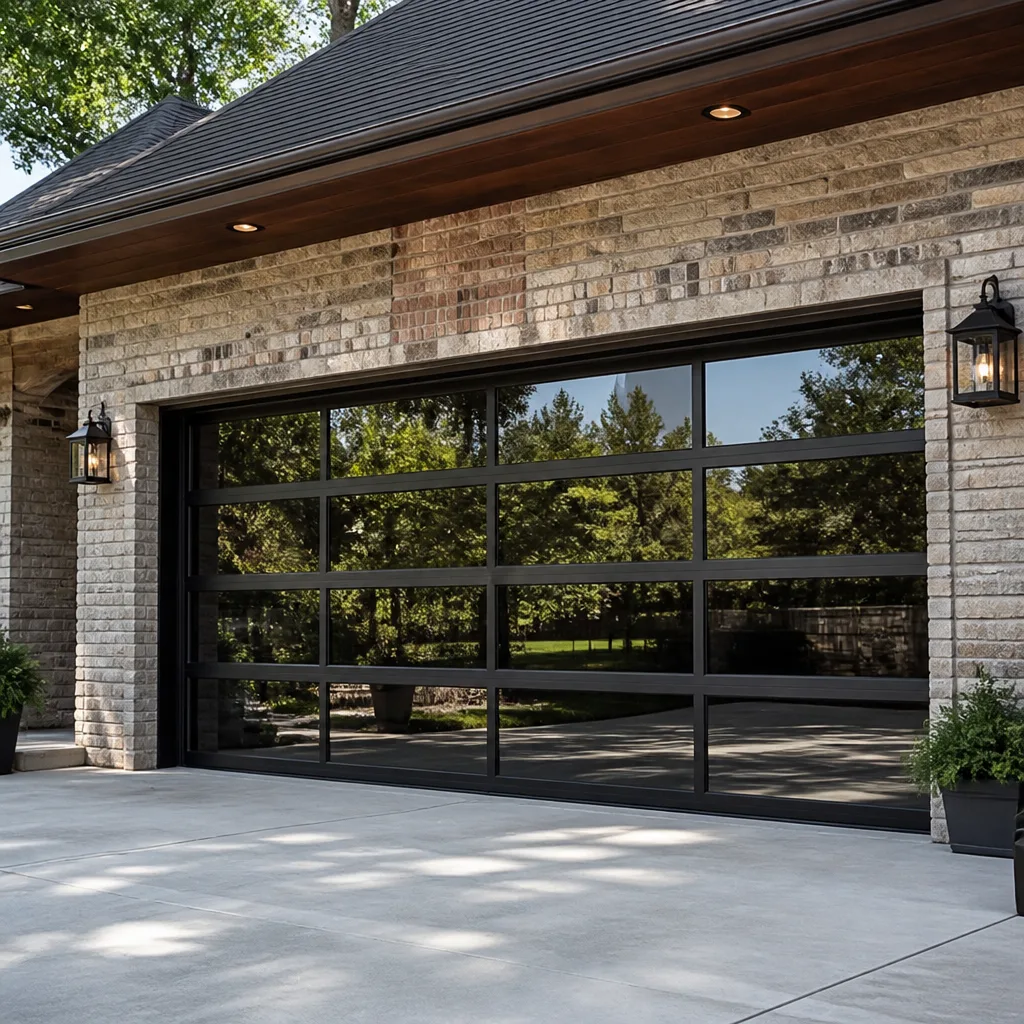 Full-view glass
 LiftMaster openers
 Chamberlain openers
Full 25-point door and opener safety check with every visit - springs, cables, rollers, tracks, and your LiftMaster or Chamberlain opener included
You get a price before we start. It does not change when the truck arrives.
Get your free estimateGarage Door Warning Signs: A Anaheim Homeowner’s Reference Guide
The grinding noise your garage door has made for six months isn’t “just how it sounds now.” It’s a roller bearing telling you exactly what’s about to fail, in the only language it has. Every garage door in Anaheim talks to its owner through sounds, movements, and small visual changes. Most people don’t listen until the door refuses to open at 7 a.m. on a workday. This guide teaches you to read those signals before they become a locked door, a caved-in panel, or a spring that lets loose in the middle of the night. For How to Hire a Garage Door Contractor in Anaheim: A Step-by-Step Guide, see our companion resource. You’ll learn which sounds point to which components, which visual clues you walk past every day, and which warning signs mean schedule service this week versus stop using the door today.
Quick Answer
Common garage door warning signs include grinding or squealing during operation, a door that hesitates or reverses mid-cycle, visible cable fraying, rust on springs, gaps under the door, and a remote that works only when you’re standing next to the opener. Most failures announce themselves days or weeks in advance. If your Anaheim garage door is making a new sound or moving differently, that’s the signal to act before the door stops moving entirely.
Styles & brands we work with
Table of Contents
- The Sounds Your Garage Door Makes and What They Mean
- Visual Warning Signs You Walk Past Every Day
- Opener Behaviors That Signal Trouble
- Week-to-Schedule vs. Stop-Using-Today Warning Signs
- Why Intermittent Problems Are the Most Dangerous
- How Anaheim’s Climate Affects Your Garage Door
- A 10-Minute Monthly Garage Door Check
- Common Mistakes to Avoid
- When to Call a Professional
The Sounds Your Garage Door Makes and What They Mean
Garage doors are mechanical systems with a limited number of moving parts. Each type of failure makes a distinct sound, and learning to read those sounds is the fastest way to catch problems early. Here’s what our technicians listen for when we get calls from homeowners in Anaheim.
Grinding
A grinding sound is metal dragging against metal without proper lubrication or alignment. In most cases it points to one of two things: roller bearings that have seized and are now scraping along the track, or a chain-drive opener whose chain has loosened and is rubbing against the rail. If the grinding is rhythmic and follows the door’s movement, it’s almost always a roller. If it comes from the opener unit itself, check the chain tension. Left unchecked, grinding rollers score the track, and a scored track means a more expensive repair than a roller replacement would have been.
Squealing
Squealing is a high-pitched metal-on-metal sound that usually comes from a lack of lubrication on the hinges, rollers, or bearing plates. Anaheim’s dry air and temperature swings can dry out factory grease faster than coastal communities with more humidity. A squealing door is the most fixable sound on this list: often a few drops of silicone-based lubricant address it immediately. But if the squeal persists after lubrication, it means the metal surfaces have already started to wear, and the component likely needs replacement rather than another round of spray.
Popping
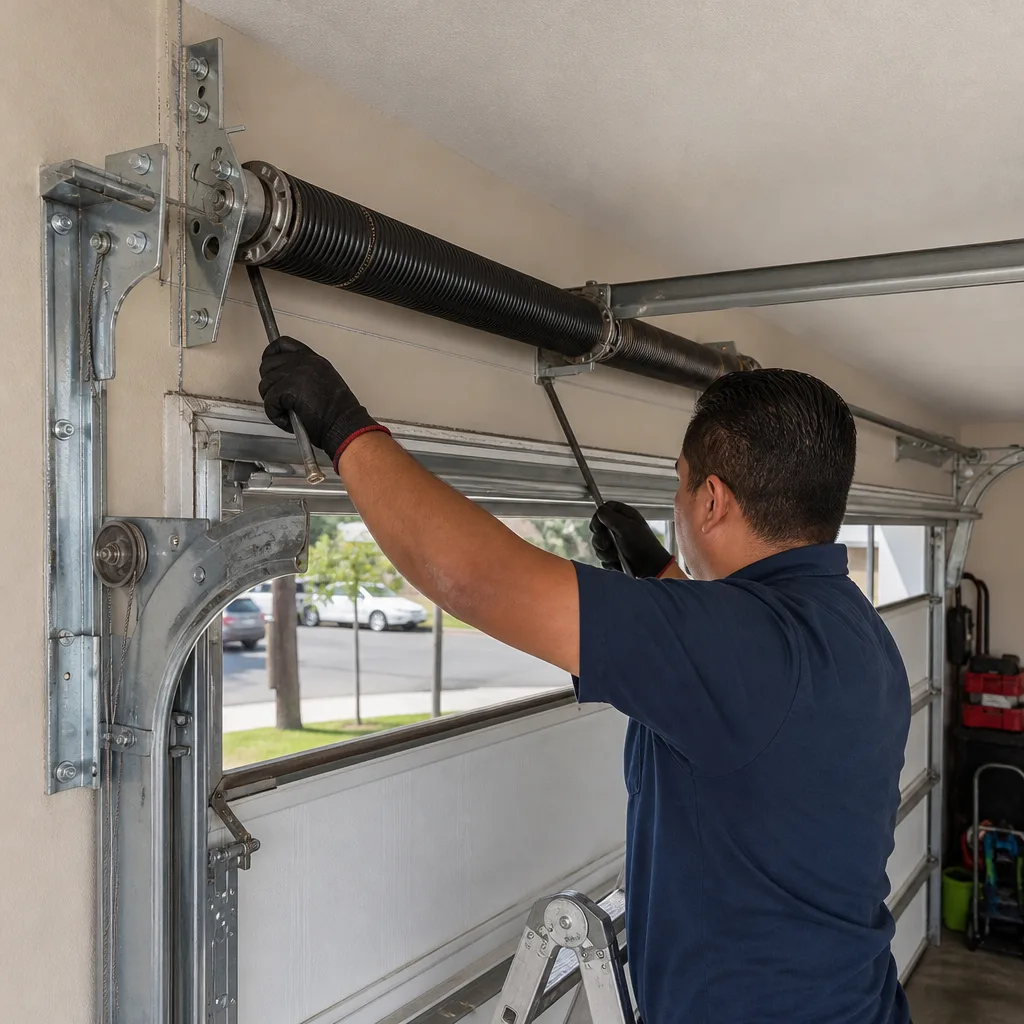
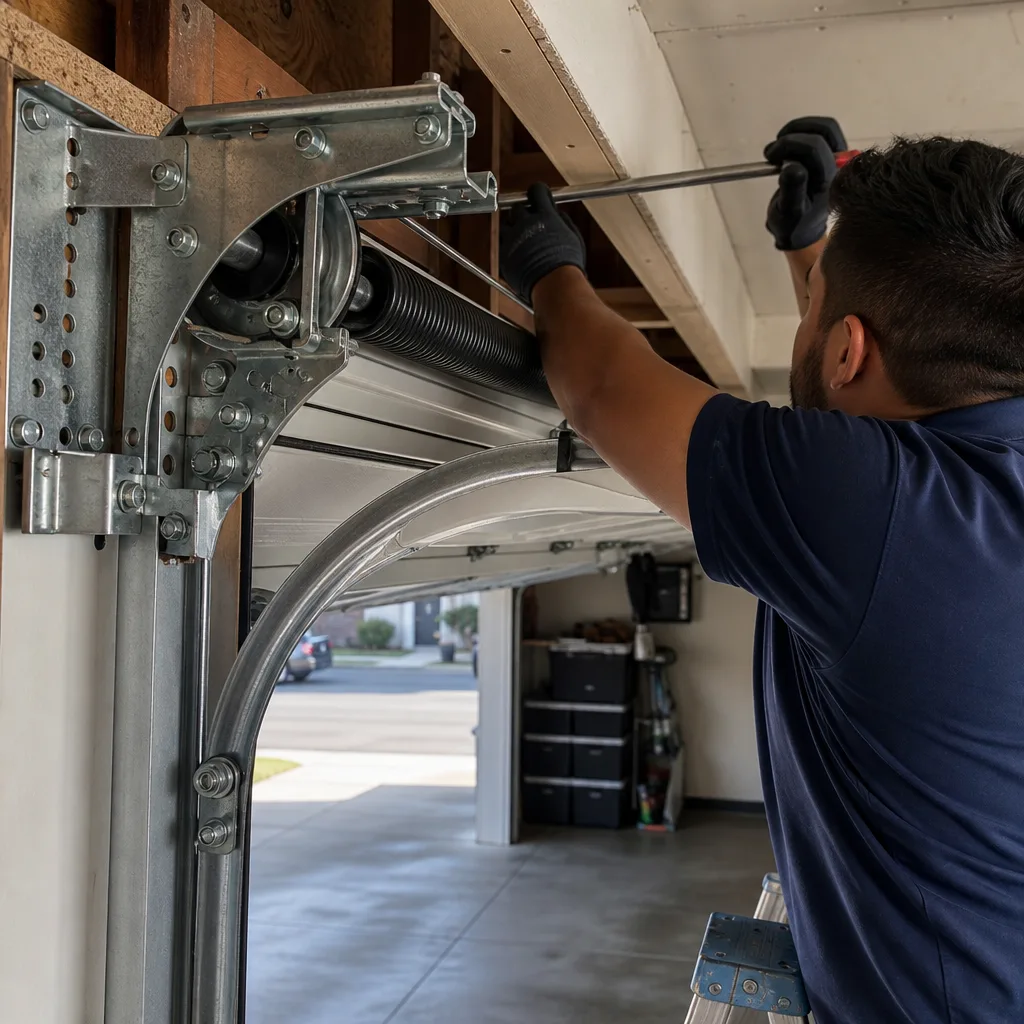
A popping or snapping sound during operation is the one homeowners should take most seriously. Torsion springs under tension will make a sharp pop when a coil begins to separate or when the spring shifts on its mounting cone. In some cases, a pop is the audible warning that a spring is about to break. Springs are under hundreds of pounds of torque even when the door is closed. If you hear a pop and the door still operates, do not attempt to adjust or inspect the spring yourself. This is the warning sign that gives you a short window to schedule service before the spring fails completely, and a high-tension spring failure can be dangerous.
Rattling
Rattling is loose hardware. Bolts and nuts vibrate loose over years of daily cycling, and an Anaheim door on a home near train lines or busy streets picks up extra vibration from the ground. A rattling door usually means the track brackets, hinge bolts, or opener mounts have worked themselves loose. Tightening what’s accessible is fine, but rattling that persists after tightening indicates a different problem: the door itself may be out of balance, causing it to shake as it moves through the cycle.
In our experience at Ranger Garage Door Service home, sound is the earliest and most reliable warning system a garage door has. If the sound is new, it’s new for a reason.
Visual Warning Signs You Walk Past Every Day
You pass your garage door twice a day at minimum. Most people see it without looking at it. These are the visual indicators that tell you something is developing, often weeks before the door fails.
Cable Fraying
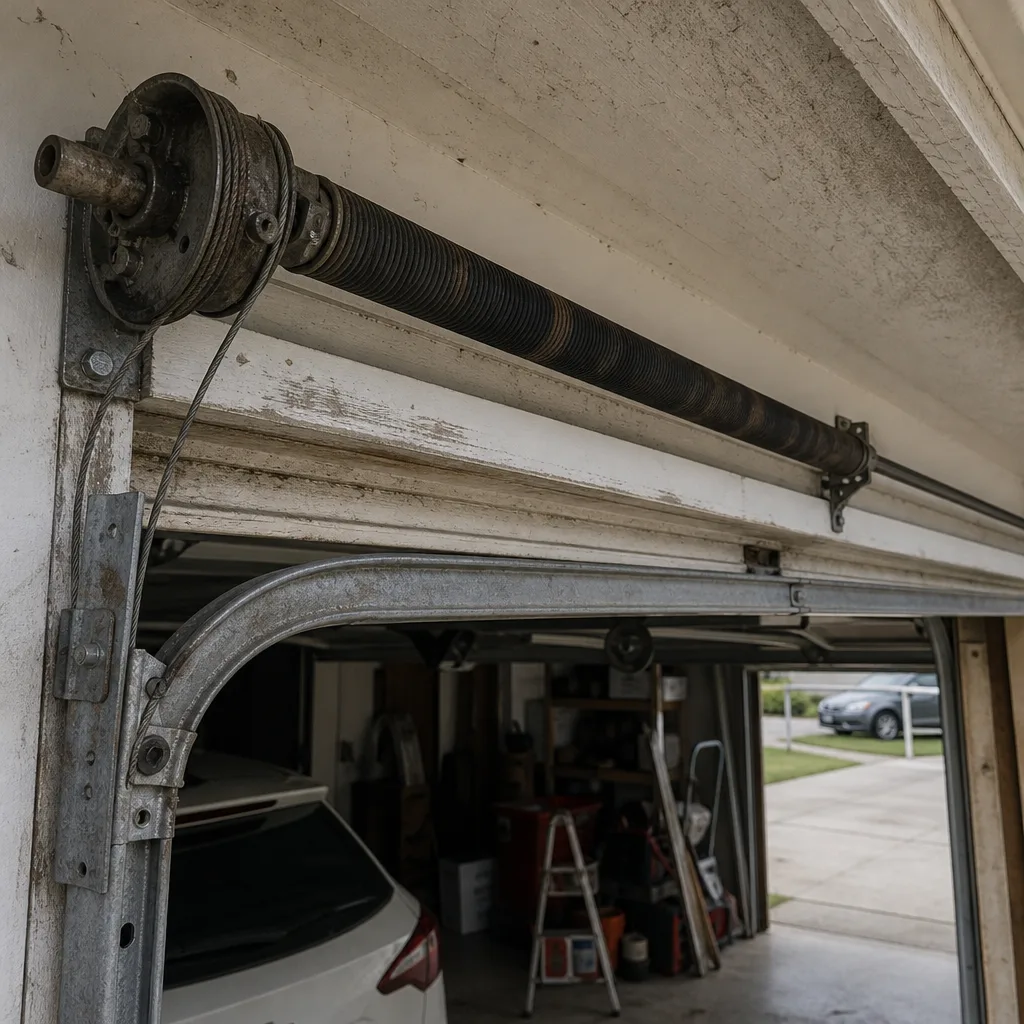
Look at the cables that run along both sides of the door and attach to the bottom brackets. If you see individual wire strands separating, that cable is in the process of failing. A frayed cable can snap without warning, and when it does, the door drops unevenly or jams in the tracks. Cables on extension spring systems also run through pulleys, and fraying there means the cable is rubbing against a worn pulley. On any door, a frayed cable is a replace-immediately item, not a monitor-it item.
Rust on Springs
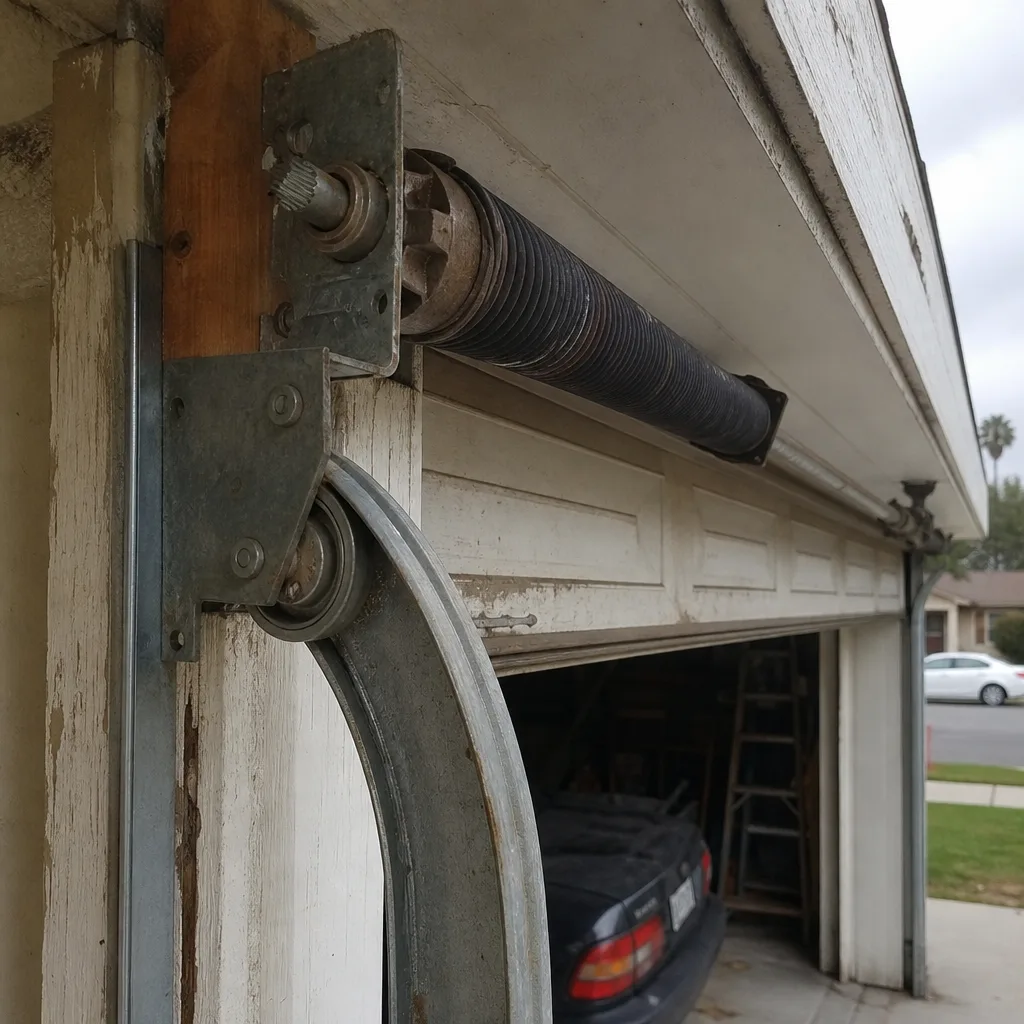
Rust is not cosmetic on a torsion spring. Rust creates friction points on the coil surface. As the spring winds and unwinds thousands of times, those rusted spots become stress concentrations where the metal is more likely to fracture. A light surface rust film is normal on older springs. Flaking, pitted rust, or rust that appears in a ring around one section of the coil means the spring’s integrity is compromised. Springs in Anaheim garages that share space with water heaters or laundry equipment rust faster because of the added ambient moisture.
Gaps in the Bottom Seal
The rubber strip along the bottom of your door does more than keep water out. It also tells you whether the door is sitting evenly. If you see daylight under one corner or a gap that isn’t there on the other side, the door may be out of level. It could be a stretched cable, a settling track, or a spring losing tension on one side. During Anaheim’s occasional heavy winter rains, a torn bottom seal also lets water into the garage, which accelerates rust on every metal component including the tracks and lower panels.
Track Alignment Tells
Stand inside the garage and look at the vertical tracks on both sides. They should be plumb and parallel. If the gap between the door and the track is wider at the top than the bottom, or if you see wear marks on only one side of the track, the door is not traveling straight. You’ll also see telltale metal dust or shavings on the floor near the track: a sign that rollers are grinding against the rail. Worn tracks from years of use are a common find in Anaheim’s older neighborhoods where homes date back to the 1950s and original hardware was built for lighter doors than what replaced them.
Panel Damage Near the Top
Pay attention to the top panel, especially on doors with a strut running across it. Cracks, dents, or a bowing top panel indicate the opener is pulling against a panel that’s already compromised. This happens when a door is slightly out of balance and the opener motor is doing more work than it should.
Opener Behaviors That Signal Trouble
The opener is the electronic brain and muscle of your garage door system. When it starts behaving differently, it’s reporting a problem somewhere in the chain, sometimes in itself and sometimes in the door it’s trying to move.
Hesitation on the Way Up
When you press the button and the door pauses for a second or two before starting to move, that’s the opener struggling against initial resistance. The most common causes are a spring that has lost tension, rollers that have begun to seize, or a door that’s out of balance. The opener is designed to move a balanced door. When the balance shifts, the opener’s motor pulls harder at the start of the cycle. Continued use will burn out the motor, the drive gear, or the circuit board, and an opener replacement costs more than a spring adjustment.
Reversing Without Obstruction
If the door starts closing and then reverses to fully open without anything in its path, the safety sensor system is misaligned or obstructed, or the opener’s force sensitivity has been tripped. On LiftMaster and Chamberlain openers, a blinking light on the motor unit after a reverse is a diagnostic code you can look up. On Genie systems, the behavior is often tied to a misaligned photo eye. Reversing may seem like a safety feature working as designed, and in one sense it is, but when it happens repeatedly, it’s a signal that the system cannot complete a cycle reliably. Ignored, it becomes a door that won’t close at all.
Shrinking Remote Range
This is one of the most commonly dismissed warning signs. Six months ago the remote worked from the end of the driveway. Now you have to be ten feet from the door. The cause is usually a failing receiver board in the opener or interference from newer electronics in the home, such as LED bulbs, smart home hubs, or wireless security systems. On openers more than ten years old, shrinking range frequently means the receiver board capacitors are degrading. It’s not a sign that the battery is weak if you’ve already replaced the remote battery and the problem persists.
The Opener Runs But the Door Doesn’t Move
If you hear the motor running but the door stays put, the most common culprit on a chain or belt drive is the drive gear inside the unit. This plastic gear wears down on all major brands including Raynor openers that use the same type of drive system. A running motor with a stationary door is a repair call in most cases. Continuing to run the opener in this state will strip what remains of the gear and can damage the sprocket.
For opener-specific diagnosis on any of these symptoms, see our Garage Door Opener Repair in Anaheim page.
Week-to-Schedule vs. Stop-Using-Today Warning Signs
Not all warning signs carry the same urgency. Our rule of thumb: if a component that supports the door’s weight is showing signs of failure, the door is not safe to use. Here’s how we sort the signals.
Signs That Give You a Week or Two to Schedule Service
- Squealing that responds to lubrication. Lubricate and the sound goes away. That’s maintenance worked as intended. Keep an eye on it.
- Rattling hardware. Tighten what’s reachable with a socket wrench. If the rattle returns in a week, schedule a service call.
- Shrinking remote range with no other symptoms. The door may work fine for months, but schedule a diagnosis before the receiver fails completely.
- Worn bottom seal with no alignment issues. A seal replacement is quick and protects the rest of the door from water damage. Schedule it, but it’s not an emergency.
Signs That Mean Stop Using the Door Today
- Popping sounds from the spring area. A spring under tension is sending its last signals. Do not run the door. Do not stand under it. Call a professional.
- Visible cable fraying. This is structural. The cable holds the door’s weight on one side. When it fails, the door can drop violently.
- A door that sits visibly crooked when closed. Something has shifted, likely a cable or spring issue. The balance is compromised and every cycle makes it worse.
- A spring with visible separation between coils. Once a spring cracks, it’s no longer providing the tension the system was designed around.
High-tension springs and cables are genuinely dangerous components. Never attempt to remove, adjust, or replace them without proper training and tools. A spring under tension can cause serious injury if mishandled. If you’re seeing any of the stop-using-today signs, leave the door closed if possible and call a trained professional.
Why Intermittent Problems Are the Most Dangerous
There’s a pattern we see in Anaheim: a homeowner calls us six months after they first noticed something strange. The door made a weird jump in March, and then it worked fine for three weeks, so they forgot about it. It did it again in May, and then again in July, and now it’s September and the door is stuck half open and a family member’s car is trapped inside.
Intermittent problems get dismissed precisely because they come and go. But the most dangerous failure mode, a broken torsion spring, is often preceded by exactly this pattern. Here’s why.
A spring with a partial crack may hold tension for days at a time. It might slip only when the temperature shifts, or when the door is cycled multiple times in a row. Then it settles back into position and behaves normally. This is not a spring that’s healing. It’s a spring that’s cycling through the final stages of its service life. The intermittent symptom is the warning. The sudden failure is what happens when the crack propagates through the rest of the coil.
The same pattern appears in opener electronics. A capacitor that’s failing will work when it’s cold, act up when it’s warm, and fail completely at the worst possible time. A drive gear with one stripped tooth will operate normally until that tooth comes around to engage, at which point the opener jumps or grinds for half a second, and then continues as though nothing happened.
Here’s the hard truth: intermittent symptoms are not normal garage door behavior. Garage doors are designed to do one thing repeatedly: open and close smoothly every time. Any deviation from that, no matter how occasional, is a component reporting degradation.
When you notice an intermittent symptom, write down what happened, when it happened, and what preceded it. Was the door sitting in the afternoon sun? Had it just been used five times in an hour? These details help a technician trace the fault faster. And when the pattern repeats, trust the pattern, not the periods of good behavior in between.
How Anaheim’s Climate Affects Your Garage Door
Anaheim’s climate does specific things to garage door systems that homeowners in other regions don’t experience. Understanding these local factors helps you separate normal wear from accelerated deterioration.
Anaheim’s dry summers pull moisture from lubricants faster than humid climates do. Grease on hinges and bearing plates hardens and cakes. Rollers that were turning smoothly start to drag. The same dry air also means rattling hardware develops earlier because there’s less moisture to swell the wooden frames of the home and keep everything seated tightly.
But Anaheim gets its occasional Santa Ana wind events and, in good years, meaningful winter rain. When rain does come, the dust and grime that accumulated on tracks and cables during the dry months turns into a grinding paste. That’s why the first storm of the season often triggers a wave of garage door service calls. The failure wasn’t caused by the rain. The rain exposed the wear that the dry months had been hiding.
Temperature swings matter too. A garage door in Anaheim can see a 40-degree difference between a summer afternoon and a predawn winter morning. Steel contracts and expands, and so does everything attached to it. Hardware that was torqued correctly expands and contracts until it’s no longer torqued correctly. This is normal, and it’s why annual inspection and tightening should be a routine for any Anaheim homeowner with a steel door.
For doors on homes built before current code requirements, the lack of insulation and sealing means the garage interior is more exposed to temperature swings than the house. That garage is its own climate zone, and the door hardware lives in it. For door repair or replacement work involving your specific setup, see our Garage Door Repair in Anaheim page.
A 10-Minute Monthly Garage Door Check
You don’t need tools or technical knowledge to perform a basic check once a month. Here’s the process we teach Anaheim homeowners who want to catch problems in the warning phase rather than the failure phase.
- Listen to a full cycle. Open and close the door once. Stand inside the garage and listen. Note any new sound, no matter how slight.
- Watch the door travel. Does it move smoothly through the entire cycle? Any jerks, shudders, or hesitations are worth investigating.
- Check the cables. Look at both sides with the door closed. Tight coils, no separating strands, no slack.
- Look at the springs. For torsion springs above the door, check for rust rings, separation between coils, or any new gap. Don’t touch, just look.
- Inspect the bottom seal. Run your hand along the rubber strip (door closed) and check for tears, gaps, or daylight coming through.
- Test the balance. Pull the emergency release handle while the door is closed. Manually lift the door to waist height and let go. It should stay in place or move only slightly. If it drops or rises, the springs need adjustment by a professional.
- Check the safety sensors. With the door open, place a shoebox in the path of the photo eyes and press close. The door should stop and reverse before touching the box.
- Wipe down the tracks. Use a dry cloth to remove any dust or grime from the inside of the vertical tracks. Don’t use grease on tracks; it collects dirt and makes things worse.
This monthly check takes ten minutes and catches most common failure modes at the earliest stage. Write down anything that seems off, and if it persists or worsens, make the call before the door makes the decision for you. Browse more guides & resources for additional homeowner tips.
Common Mistakes to Avoid
- Ignoring a new sound because the door still works. Every mechanical failure starts while the system is still functional. That’s what the sound is telling you now.
- Lubricating the tracks to fix a grinding noise. Grease attracts grime, which turns into a grinding paste, which makes the problem worse. Lubricate the rollers and hinges; keep tracks dry.
- Spraying WD-40 on everything. WD-40 is a water displacer and light solvent, not a long-term lubricant. Use a silicone-based garage door lubricant on rollers, hinges, and bearing plates.
- Replacing the remote battery to fix shrinking range. That’s the first thing to try, but if it doesn’t solve the problem, the receiver board is the likely culprit and no amount of fresh batteries will fix it.
- Adjusting or replacing springs without training. Torsion springs carry deadly tension. This is not a DIY project and never worth the risk.
- Waiting until the door fails to research a repair company. The worst moment to choose a service provider is during an emergency. Anaheim homeowners who have a relationship with a garage door company before the failure get faster service and better outcomes.
- Assuming an old door just “needs to be replaced” because it’s acting up. Many problems on older doors are repairable for a fraction of replacement cost. A legitimate repair company will tell you when repair makes sense and when replacement is genuinely the better investment. If you’re weighing that question, see our Garage Door Installation in Anaheim page for honest guidance.
When to Call a Professional
Call a professional the same day you notice any stop-using-today sign: popping from the spring area, visible cable fraying, a door sitting crooked, or a spring with visible coil separation. Call within the week for persistent sounds that don’t resolve with basic lubrication, opener behaviors like hesitating or reversing that repeat more than once, or a balance test where the door won’t hold position at waist height.
Also call when you’re simply not sure. A quick diagnosis by someone who has seen thousands of doors costs less than a failed spring, a burned-out opener motor, or a damaged car. We work on eight major garage door and opener brands including LiftMaster, Chamberlain, Genie, and Raynor, so the diagnosis is grounded in the system you actually own, not just the one brand a servicer happens to prefer. See Choosing the Right Garage Door Brand: A Buyer’s Guide for Anaheim if you’re considering an upgrade. Ranger Garage Door Service offers free estimates in Anaheim, call (877) 752-4135 and we’ll tell you what we find and what it costs to fix before any work begins.
See the difference
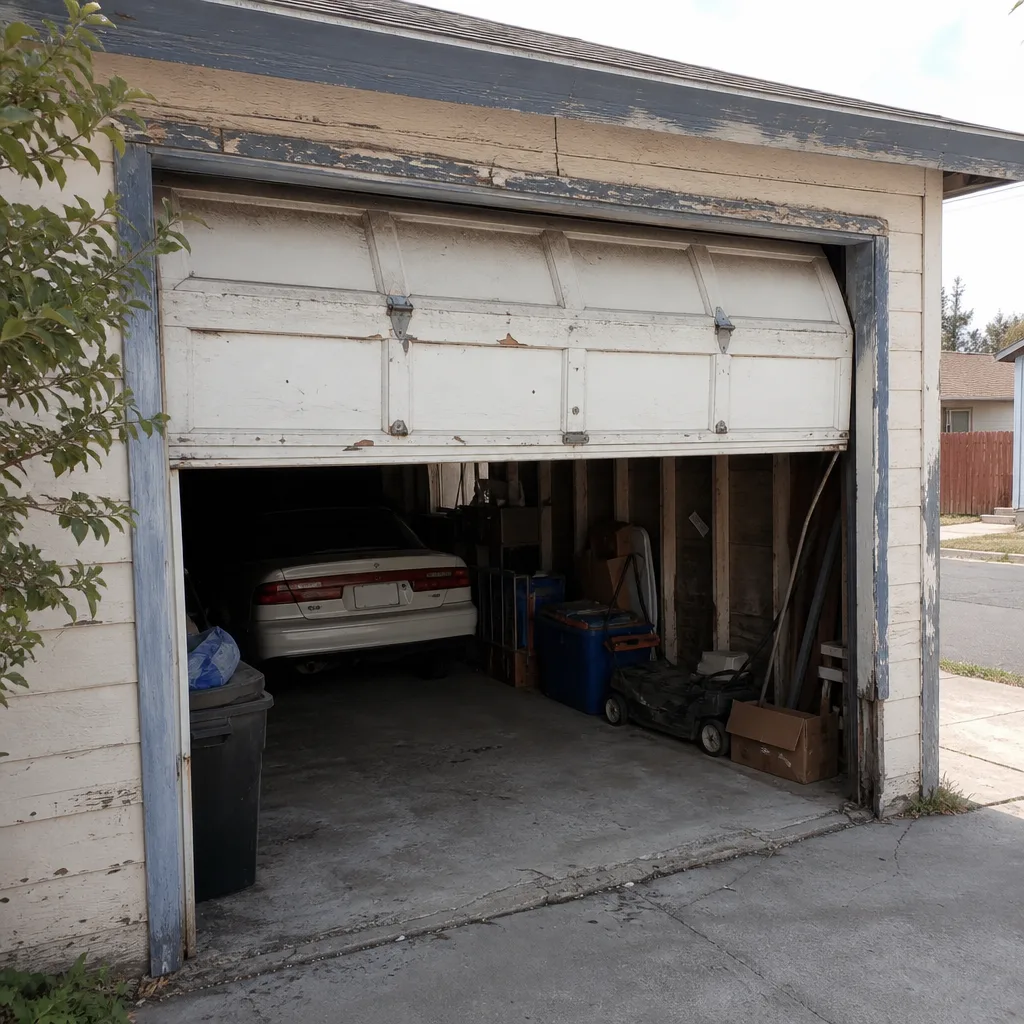 Before
 After
 Before
 After
 Before
 After
Frequently Asked Questions
A grinding noise during operation usually means one or more roller bearings have seized and are scraping against the track, or the chain on a chain-drive opener has loosened and is rubbing the rail. Roller-related grinding is the more common of the two in Anaheim’s dry climate, which hardens bearing grease faster. If lubricating the rollers doesn’t quiet the noise within a day, the rollers likely need replacement. Call (877) 752-4135 for a diagnosis and an exact quote before any work starts.
Spring replacement in Anaheim typically falls in the $180 to $350 range depending on the spring type, door weight, and whether you’re replacing one spring or both. We quote the exact price after seeing your setup, and that price is agreed before any work begins. Replacing both springs at once, even when only one has broken, is standard practice because both have cycled the same number of times. Call (877) 752-4135 for a free estimate.
A door that stops partway through its travel is usually reporting a balance problem, a bound roller, or an opener force setting that has been tripped by increased resistance. If it happens more than once, the underlying cause is getting worse each time it occurs. Continuing to run the door in this condition stresses the opener motor and the door panels. Call us for an inspection before it becomes a full stop.
Emergency garage door service in Anaheim is available, and in many cases we can have a technician at your door the same day. Call (877) 752-4135 as early as possible and describe what happened. If your car is trapped in the garage, tell us that when you call so we can prioritize accordingly.
No. The price we quote is the price you pay, and it’s quoted after we inspect the door and show you what we found. You always get the full picture before approving any work. If you call with symptoms, we’ll give you an honest range over the phone, then confirm the exact number on site before a single part is ordered or removed.
Yes. We stock parts for the major brands homeowners already have installed, including springs, cables, rollers, hinges, and opener components for LiftMaster, Chamberlain, Genie, and Raynor systems. The goal is one trip, one fix, and your door working again the same day. That’s why we service eight major brands rather than specializing in just one or two: we can repair what’s actually on your house.
The Bottom Line
Your garage door announces its problems before it stops working. Grinding means bearings are done. Popping means a spring is in its final days. Frayed cables mean structural failure is close. Hesitating openers mean the motor is working harder than it should. None of these signals repair themselves, and none of them get cheaper by waiting. Anaheim’s dry air and temperature swings accelerate normal wear, but a monthly ten-minute check catches most problems in the warning phase. When you hear something new, see something different, or just aren’t sure, one call gets you an honest diagnosis and a clear price. The alternative is the door making the decision for you, and it never chooses a convenient time.
Written by the team at Ranger Garage Door Service, serving Anaheim since 2018.
Ready for a professional inspection? Call Ranger Garage Door Service at (877) 752-4135 for a free estimate on any garage door repair, opener repair, or new installation in Anaheim.